How to Maintain Massage Chair Upholstery: 2026 Care Guide
Table of Contents
- Start With Your Upholstery Material, Not a Cleaning Product
- Massage Chair Cleaning Supplies You Actually Need
- Step-by-Step: How to Clean Massage Chair Upholstery
- Preventing Synthetic Leather Cracking, Peeling, and Fading
- How to Remove Stains, Sweat, and Body Oils From Massage Chair Upholstery
- Your Massage Chair Maintenance Schedule at a Glance
- Cleaning vs. Sanitizing: What Each One Actually Does
- Conclusion
- Frequently Asked Questions
Last Updated: September 11, 2026
Start With Your Upholstery Material, Not a Cleaning Product
Learning how to maintain massage chair upholstery starts with one question: what is your chair covered in? Most chairs use synthetic leather (PU or bonded leather), vinyl, or woven fabric or mesh. Each reacts differently to cleaners, so the wrong product can do more damage than the dirt.

The material decides the method.
Massage-chair upholstery can include synthetic leather, vinyl, fabric, mesh, or combinations of materials. Each material can have different cleaning and care requirements, so identify the upholstery used on your specific chair before choosing a cleaner or maintenance method.
Check the tag or manual under the seat before you buy a single cleaning product. If the manufacturer lists a specific care instruction, that instruction wins over anything in this guide.
Massage Chair Cleaning Supplies You Actually Need
The supplies you need depend on your chair’s upholstery and the manufacturer’s care instructions. Common maintenance tools may include microfiber cloths and a vacuum with a soft upholstery attachment, while any cleaner or conditioner should be compatible with the specific material on your chair.
Skip specialty "leather wipes" unless the manufacturer names them. Most contain solvents that are fine on genuine hide and harsh on polyurethane. If the manufacturer permits a mild cleaning solution, use the type and dilution recommended in the care instructions rather than assuming that a household soap is appropriate for every upholstery material.
Here's what belongs in your massage chair cleaning supplies:

- Microfiber cloths
- Vacuum with a soft upholstery attachment, if appropriate for the material
- Manufacturer-approved upholstery cleaner, when needed
- Manufacturer-approved conditioner, if recommended
- Any additional tools specified in the chair’s care instructions
- Keep the solution weak, stronger isn't cleaner, it just leaves dust-attracting residue.
Step-by-Step: How to Clean Massage Chair Upholstery
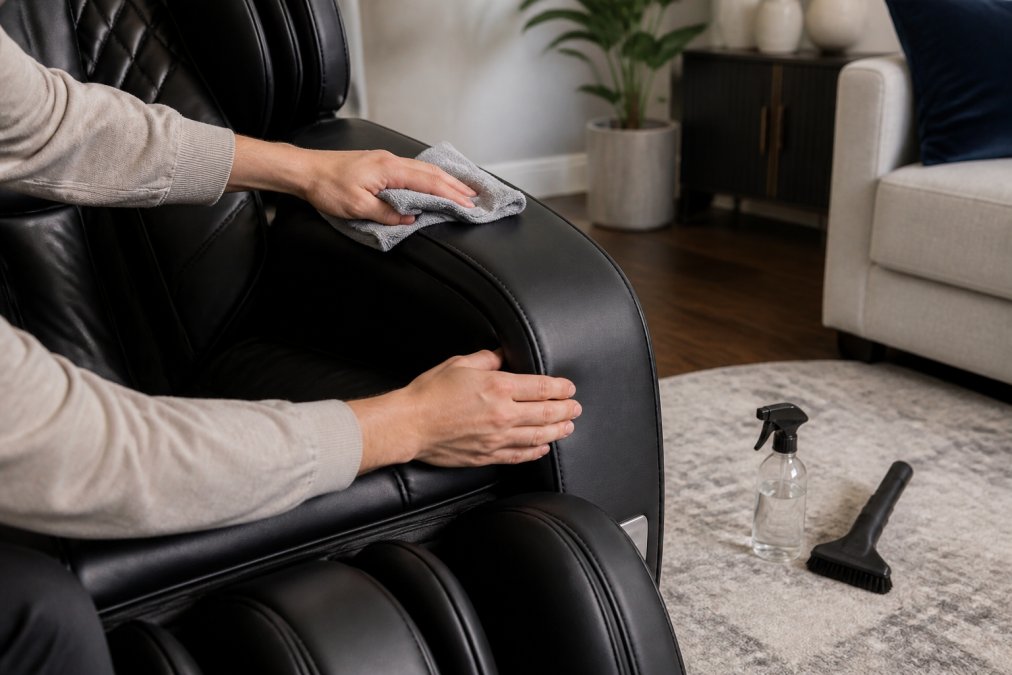
Work top to bottom, and always vacuum before you introduce any moisture.
Daily and Weekly Wipe-Down Routine
Sweat and body oils are the main enemies of massage chair upholstery, and they work quietly.
Keep high-contact surfaces clean according to the chair manufacturer’s care instructions. Wipe away visible sweat, oils, spills, or debris as needed using a method that is approved for the upholstery material. Avoid excess moisture unless the manufacturer specifically permits it.
The rule that matters: never let liquid sit. A damp cloth, not a wet one.
Deep Cleaning Fabric and Mesh Surfaces
Fabric and mesh surfaces may require different cleaning methods than synthetic leather or vinyl. Review the manufacturer’s instructions before applying water, detergent, stain remover, or upholstery cleaner. If vacuuming is permitted, use an appropriate soft attachment and avoid damaging seams, sensors, or other components. Allow any cleaned surface to dry fully before using the chair again.
Preventing Synthetic Leather Cracking, Peeling, and Fading
Most peeling starts as dryness, and dryness is preventable, but the fix depends on which coating you have. Synthetic leather (PU), vinyl (PVC), and bonded leather fail differently.
Why each material fails
- Different synthetic upholstery materials age differently depending on material quality, heat, sunlight, friction, humidity, cleaning products, and frequency of use. Over time, some materials may fade, stiffen, crack, peel, or show wear at high-contact and flex points. The manufacturer’s care recommendations are the best guide for reducing premature wear.
The three levers you actually control
- Sunlight and heat: Prolonged direct sunlight or excessive heat may accelerate fading or material aging on some upholstery.
- Cleaning products: Use only products that are compatible with your chair’s specific upholstery.
- Friction and wear: Periodically inspect high-contact areas, seams, hinges, and flex points for early signs of wear.
Conditioning: what to use and how often
Use a product labeled for synthetic leather, PU, or vinyl. Apply a small amount to a microfiber cloth, not directly to the chair, work it in thin layers, and buff off the excess with a dry cloth. Excess product attracts dust and leaves a greasy film that traps grit.
Conditioning frequency varies by product, climate, and use. Follow the conditioner and chair manufacturers' directions; if neither specifies an interval, condition when the surface starts to feel dry or slightly stiff rather than on a fixed calendar.
What to Do if You Notice Cracking or Peeling
If you notice cracking, peeling, a puncture, torn stitching, or another upholstery problem, photograph the damage and check your warranty documentation before attempting a repair. Contact the manufacturer or retailer to ask whether replacement upholstery, approved repair materials, or professional service is available.
Avoid applying adhesives, fillers, dyes, conditioners, or repair kits unless they are recommended for your chair’s specific upholstery. An unauthorized repair may worsen the damage or affect warranty coverage.mmon with bonded leather), DIY repair stops being practical. Replacement covers, if the manufacturer offers them, or professional reupholstery are the realistic options.
Fading
Fading is a UV and oxidation problem, not a cleaning problem, and no conditioner restores pigment. If your chair receives significant direct sunlight, consider reducing prolonged UV exposure by repositioning the chair, using blinds or curtains, or following any protective measures recommended by the manufacturer. For already-faded areas, a flexible dye for synthetic materials can even out color, but results vary and it's cosmetic.
How to Remove Stains, Sweat, and Body Oils From Massage Chair Upholstery
Act fast, blot don't rub, and match the method to the stain. Blot fresh spills immediately with a dry cloth. For sweat and body oils, a cloth dampened with lukewarm water and a drop of mild detergent usually lifts the residue. Work from the outside of the stain inward so you don't spread it.
Stain removal by type:
Stain Type |
First Step |
Solution |
Watch Out For |
|---|---|---|---|
Sweat and body oils |
Blot or wipe promptly using the manufacturer-approved method |
Lukewarm water, mild detergent |
Residue attracts dust |
Food or drink |
Blot gently and check the care instructions before applying cleaner |
Diluted mild soap |
Sugar left behind turns sticky |
Ink or dye transfer |
Avoid aggressive rubbing or solvents; contact the manufacturer for guidance |
Conditioner, then mild soap |
Rubbing spreads the mark |
Pet accidents |
Blot promptly and use only a cleaner approved for the specific upholstery |
Enzyme cleaner for fabric only |
Never on synthetic leather |
For fabric and mesh, an enzyme-based cleaner handles organic stains that soap can't break down. Test any product on a hidden area first, like under the seat or behind the backrest.
Your Massage Chair Maintenance Schedule at a Glance
Maintenance frequency depends on upholstery material, frequency of use, household conditions, and manufacturer recommendations. Rather than following a universal schedule, inspect the chair regularly and follow the cleaning and conditioning intervals specified for your particular model.
Cleaning vs. Sanitizing: What Each One Actually Does
Cleaning removes dirt, oils, and organic residue; sanitizing reduces germs on a surface; disinfecting goes further and is intended to kill or inactivate specific pathogens listed on the product label (the CDC). On massage chair upholstery the order matters: cleaning always comes first, because soil blocks the sanitizer's active ingredient from reaching the surface.
Why this is trickier on a massage chair than on a countertop
Massage chair upholstery is a mix of materials, PU or vinyl on the main panels, fabric or mesh on others, often plastic trim and stitching in between. A product safe on one panel can discolor or dry out another. The seat, armrests, and headrest also see more skin contact than almost any other home surface, making them the priority zones.
Choosing a sanitizer or disinfectant
Do not assume that a household disinfectant is safe for massage-chair upholstery. A product that is appropriate for one material may discolor, dry, soften, or otherwise damage another.
If sanitizing or disinfecting is necessary, first check the chair manufacturer’s care instructions. Use only a product that is labeled for the specific upholstery material and follow the product label for dilution, application, contact time, drying, and ventilation.
What to look for instead
For synthetic leather and vinyl, look for a product labeled safe for those materials, often marketed as "vinyl safe" or "upholstery safe." For fabric and mesh, a fabric-safe sanitizing spray or an EPA-registered disinfectant labeled for upholstery is appropriate; follow the label's directions.
The contact-time rule
Every EPA-registered disinfectant or sanitizer has a required contact time, the minutes the surface must stay visibly wet to work as claimed (the EPA). It's printed on the label and varies widely by product. Don't shorten it or let the surface dry out early; if it dries, reapply.
A material-safe sequence for a shared chair
- Clean the surface using the chair manufacturer’s approved method before sanitizing or disinfecting. If a compatible sanitizer or disinfectant is used, follow its label instructions exactly and make sure it is appropriate for the chair’s upholstery. Avoid oversaturating seams or surfaces near electrical components.
How often
Frequency depends on use and household. A chair used by one person who isn't ill generally doesn't need routine sanitizing, regular cleaning is enough. A chair shared by multiple people, used in a gym or office, or used during cold and flu season benefits from sanitizing more often. There is no universal interval; err toward sanitizing after any session by someone visibly ill, and otherwise follow the manufacturer's care guidance.
Conclusion
Upholstery is the part of a massage chair you touch every day, and the first to show wear when care slips. Match your care method to the upholstery material, avoid unnecessary moisture and harsh cleaners, limit prolonged direct sunlight when practical, and follow the manufacturer’s recommendations for cleaning and conditioning. Those four habits prevent most of the cracking, peeling, and fading that shorten a chair's life.
When you're ready for a chair built to hold up, RejuvaZone carries full-body massage chairs designed for daily recovery routines, including the M9 Zero Gravity Massage Chair with 3D roller technology and the Zero Gravity Massage Chair with heat and Bluetooth audio. Both come with a real support team available for post-delivery questions, including care and maintenance guidance. Shop now and start a recovery ritual you can keep up with.
Frequently Asked Questions
How often should I clean my massage chair upholstery?
Wipe down high-contact areas like the headrest, armrests, and seat after each use with a dry or slightly damp microfiber cloth. A deeper clean with a mild soap solution fits a weekly or biweekly routine. Frequency also depends on how much you sweat during sessions, whether pets share the chair, and the material. Check your chair's care instructions, since manufacturers may specify different intervals for fabric, vinyl, or synthetic leather.
Can I use standard leather cleaners on my massage chair?
Not always. Many household leather cleaners contain solvents, alcohol, or silicone that can dry out synthetic leather, vinyl, and PU surfaces, which may lead to cracking or peeling over time. Use a pH-neutral mild detergent diluted in lukewarm water, or a product the manufacturer explicitly approves for your chair's material. Always test any cleaner on a hidden area first and follow the care instructions that came with your chair.
What is the best way to prevent cracking in synthetic massage chair leather?
Keep the material clean, conditioned with a manufacturer-approved product, and out of direct sunlight. UV exposure and heat are two of the biggest drivers of fading and brittleness in synthetic leather. A damp cloth wipe-down removes the sweat and body oils that break down surface coatings, and a leather conditioner made for synthetic materials can help maintain flexibility. Avoid abrasive cleaners and harsh chemicals, which strip the protective layer.
Is it possible to reupholster a massage chair if the material wears out?
Yes, reupholstery is possible, but it depends on the chair's construction and whether replacement covers or parts are still available. For minor issues like small cracks or peeling edges, a repair kit or patch may extend the life of the upholstery. For larger damage, contact the manufacturer first to ask about replacement covers. Following a consistent maintenance schedule is the most reliable way to delay the need for reupholstery.