Red Light Therapy Eye Safety Tips: Protect Your Eyes
Table of Contents
- Why Eye Protection Matters During Red Light Therapy
- Red Light Therapy Eye Protection Goggles: What to Look For
- How to Use Red Light Therapy Safely: Step-by-Step
- Red Light Therapy Session Duration: Finding Your Safe Limit
- Photosensitivity, Medications, and Eye Safety
- Pediatric and Adolescent Eye Safety Considerations
- Frequently Asked Questions
Last Updated: September 12, 2026
Why Eye Protection Matters During Red Light Therapy
Red light therapy devices can emit bright visible red and near-infrared light, so eye safety deserves careful attention. The appropriate precautions depend on the device, wavelength, intensity, treatment area, and manufacturer guidance. This guide from RejuvaZone explains what the research actually says, where the risks are real, and how to build a routine that protects your vision without giving up your sessions.
Photobiomodulation is the process by which red and near-infrared light interact with cells to support energy production and normal tissue function. It is not the same as UV exposure. Red light therapy devices use light-emitting diodes that emit non-ionizing radiation, typically at 630-670nm (red) and 810-850nm (near-infrared) (the FDA). Non-ionizing means these wavelengths lack the energy to break chemical bonds or damage DNA the way ultraviolet light can.
That distinction matters, but it is not a free pass. Bright light exposure may cause glare, after-images, or visual discomfort, and potentially harmful exposure may not always produce an immediate warning sensation. For that reason, users should not rely on comfort alone to judge whether an exposure is appropriate. Follow the device manufacturer’s eye-safety instructions.
Some light-emitting devices are regulated by the FDA depending on their intended use and product classification. FDA regulation or clearance should not be interpreted as a substitute for following the safety instructions provided for the specific device.
Understanding Photobiomodulation and Your Eyes
The eye is a light-focusing instrument. The eye focuses incoming visible light onto the retina, which is one reason direct viewing of a bright light source deserves more caution than exposing skin to the same device. Eye-safety recommendations should be based on the specific device and its manufacturer guidance.
Ocular health researchers distinguish between two concerns: phototoxicity (light-driven chemical damage to retinal tissue) and visual discomfort (the immediate glare, after-images, and light sensitivity that follow direct exposure). The first is the one that matters long-term.
What most guides miss is that risk scales with proximity and duration, not just device power. Sitting 6 inches from a high-output panel for 20 minutes is a different exposure event than sitting 3 feet away for 5 minutes.
Red Light Therapy Eye Protection Goggles: What to Look For
If your device manufacturer recommends protective eyewear, use eyewear that is compatible with the device and intended for the wavelengths it emits. Not all goggles are built for this.
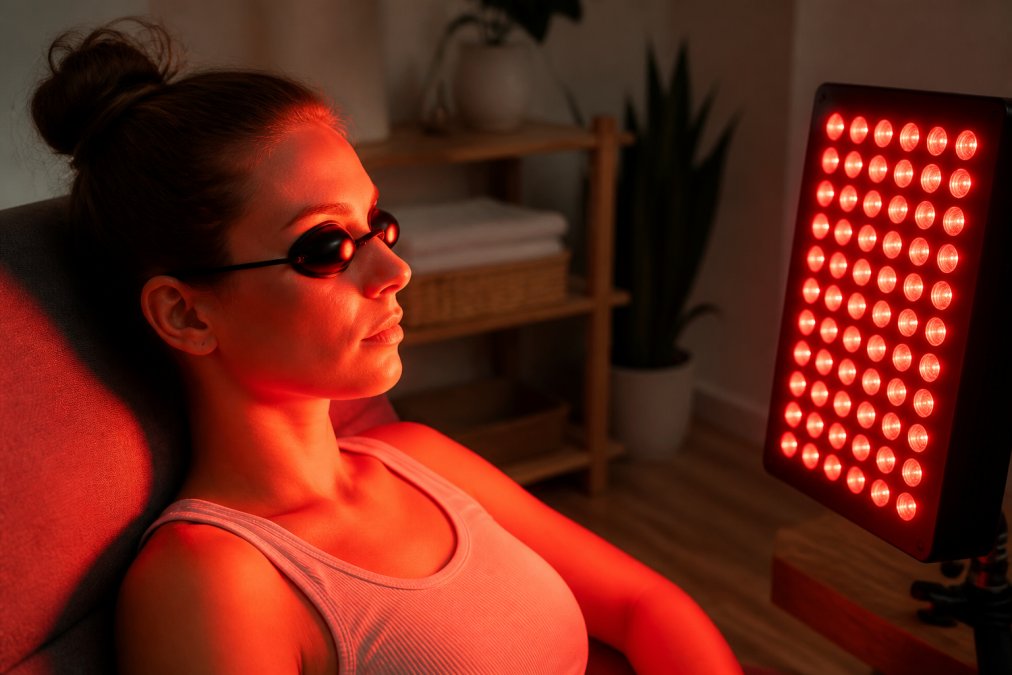
Protective eyewear for light therapy falls into three rough categories:
- Opaque blindfold-style covers that block all light. Best for full-body panels where you do not need to see.
- Tinted filter goggles that block specific wavelength bands while letting you see the room.
- Third-party goggles or eye shields should only be used if their specifications are appropriate for the device and the manufacturer provides adequate compatibility information.
Certification Standards and Lens Types
This is the gap most articles skip. In the United States, protective eyewear is not automatically certified for light therapy use. Eye-protection standards vary by application, and standards developed for general workplace protection or lasers are not automatically the correct standard for every LED-based wellness device. The most relevant guidance is the eye-protection information supplied for the specific device.
Ask the device manufacturer which wavelengths their goggles are rated to block and at what optical density. If they cannot answer, that is your answer.
- Confirm the goggle's rated wavelength range covers your device's output (red, near-infrared, or both)
- Check for a documented optical density or transmission figure
- Verify the fit seals around the eye socket without gaps
- Confirm the manufacturer lists the goggles as compatible with your specific device model
How to Use Red Light Therapy Safely: Step-by-Step
Safe use comes down to a repeatable routine, but the reason each step exists matters more than the step itself. Here is the sequence, with the mechanism behind it.
- Read your device's manual first, and locate the eye-protection line specifically. Every manufacturer sets its own recommended distance, session length, and eye-protection requirement. Follow theirs, not a generic internet number. If the manual does not mention eye protection at all, treat that as a gap to resolve with the manufacturer before your first session.
- Use any eye protection required or recommended by the manufacturer before beginning the session. Do not remove it during use unless the manufacturer’s instructions specifically allow that.
- Use the manufacturer’s recommended distance. Do not move closer in an attempt to increase intensity or accelerate results.
- Do not assume that closing your eyes is an adequate substitute for manufacturer-recommended eye protection. Follow the device instructions for eye position and protective eyewear.
- Use the device’s recommended session duration and timer settings. Do not extend treatment beyond the manufacturer’s instructions.
- Stop use if you experience persistent visual discomfort, significant after-images, eye pain, or other unusual symptoms. Seek appropriate medical advice if symptoms do not resolve promptly.
Common Mistakes to Avoid
The recurring errors are predictable, and each one has a specific failure mode:
- Removing goggles "just to check" mid-session. This reintroduces direct exposure at the moment your eyes are already adapted to the dim room, which is when glare response is strongest.
- Lying closer than the manual specifies because it feels more intense. Intensity is not the goal; the manufacturer's distance is calibrated to their device's output.
- Using a device with no eye-protection guidance and assuming none is needed. Silence in a manual is not a clearance.
- Sharing one pair of goggles between two people with different devices. A goggle rated for one wavelength band may not block another.
Some users may experience visual discomfort, glare, after-images, or eye irritation with bright-light exposure. Persistent, severe, or unusual symptoms should be discussed with an eye-care professional rather than self-diagnosed.If you already take medications that increase light sensitivity, the calculus changes, see the photosensitivity section below.
Red Light Therapy Session Duration: Finding Your Safe Limit
There is no universal safe session duration for red light therapy. Recommendations vary by device, wavelength, intensity, and the individual user. Follow your manufacturer's instructions, and if they do not specify a duration, contact them before your first session.
This is where a lot of content gets it wrong. Generic "10 to 20 minutes" advice ignores that a 660nm panel at low intensity and an 850nm high-output panel are not interchangeable.
What you can control:
- Follow the manufacturer’s recommended session duration.
- Use the recommended distance and intensity settings.
- Use eye protection when instructed.
- Stop use and seek guidance if you develop persistent or unusual visual symptoms.
For a full-body setup, an opaque blindfold is usually the simplest solution. For targeted facial use, wavelength-appropriate goggles matter more because your eyes are closer to the source.
Photosensitivity, Medications, and Eye Safety
Some medications and medical conditions can increase sensitivity to light or affect how a person responds to light-based devices. This is the angle most red light therapy articles skip entirely, and it is the one that matters most for readers over 40 who take daily prescriptions.
If you take a medication with a photosensitivity warning, or if you have an eye condition or other medical concern, ask a pharmacist, prescribing clinician, or eye-care professional whether use of your specific light-therapy device is appropriate. It is a reason to be more conservative and to ask your ophthalmologist or pharmacist whether any of your current medications carry a photosensitivity warning.
If you have a diagnosed eye condition, a history of retinal issues, or you are currently being treated for an eye problem, talk to your eye care provider before starting. Preventative measures are cheap.
Pediatric and Adolescent Eye Safety Considerations
Red light therapy devices may have age restrictions or special safety instructions for children and adolescents. Do not assume that settings intended for adults are appropriate for younger users.
Before allowing a child or teenager to use a red light therapy device, review the manufacturer’s age guidance and safety instructions. If the device does not provide pediatric-use guidance, contact the manufacturer before use.
For devices being considered for skin or other wellness purposes in children or adolescents, consult an appropriate healthcare professional when there is any uncertainty about safety, eye protection, medications, or an underlying medical condition.
Do not create a reduced adult protocol or attempt to estimate a child’s session duration, intensity, or distance on your own.
Frequently Asked Questions
How do I protect my eyes during red light therapy?
Wear wavelength-appropriate protective eyewear, such as goggles or a blindfold, that blocks the specific wavelengths your device emits (typically 660nm and 850nm). Follow the manufacturer's instructions for your device. If you have any eye conditions or concerns, consult an ophthalmologist before use. Closing your eyes alone may not be enough because light can penetrate through eyelids.
Is closing your eyes enough to protect them from red light therapy?
Closing your eyes reduces but does not eliminate exposure. Light can pass through eyelids, especially high-intensity LED light. For adequate protection, use dedicated goggles or a blindfold designed for red light therapy. Always check your device's manual for specific eye safety recommendations.
What do ophthalmologists think of red light therapy?
Ophthalmologists generally agree that while red light therapy is non-ionizing and considered low-risk, direct exposure to high-intensity light can cause temporary visual discomfort, after-images, or corneal irritation. They recommend protective eyewear and following manufacturer guidelines. Some research explores red light therapy for certain eye conditions, but this should only be done under professional supervision.
Are there specific FDA-cleared eye protection standards for light therapy?
The FDA does not have specific clearance standards for eye protection used in red light therapy. However, protective eyewear should meet general safety standards for light-blocking. Look for goggles that specify blocking the wavelengths your device emits. Always prioritize products from reputable manufacturers and follow device instructions.