Massage Chair Repair and Parts Guide: Fix It Yourself
Table of Contents
- Safety First: Before You Open the Chassis
- Massage Chair Troubleshooting Guide: Power, Error Codes, and Reset Steps
- How to Find Massage Chair Replacement Parts
- Massage Chair Maintenance Tips That Prevent Breakdowns
- Massage Chair Warranty Coverage: What's Protected and What Isn't
- When to Call a Technician Instead of DIY Repair
- Frequently Asked Questions
Last Updated: September 14, 2026
Safety First: Before You Open the Chassis
Before removing any panel or opening the chassis, check the manufacturer’s service and warranty instructions. Unplugging the chair does not necessarily make every internal electrical component safe to touch, and some repairs should only be performed by qualified service personnel. If the manufacturer does not specifically authorize owner access to the chassis, contact technical support or a qualified technician.

Most guides skip this part. The ones that do usually assume you already know what a capacitor does.
- Confirm the outlet is switched off at the breaker if you can reach it
- Pull the plug and wait before touching the power supply unit
- Photograph every connector before you disconnect it
- Work on a dry floor with good overhead light
- Keep the service manual open beside you
- Stop if you see scorched wiring, a bulging capacitor, or a burning smell
The last item matters more than the rest. Burnt insulation or a swollen capacitor is a sign the board has already failed, and no amount of cleaning or reseating will bring it back. At that point you are replacing components, not repairing them.
Massage Chair Troubleshooting Guide: Power, Error Codes, and Reset Steps
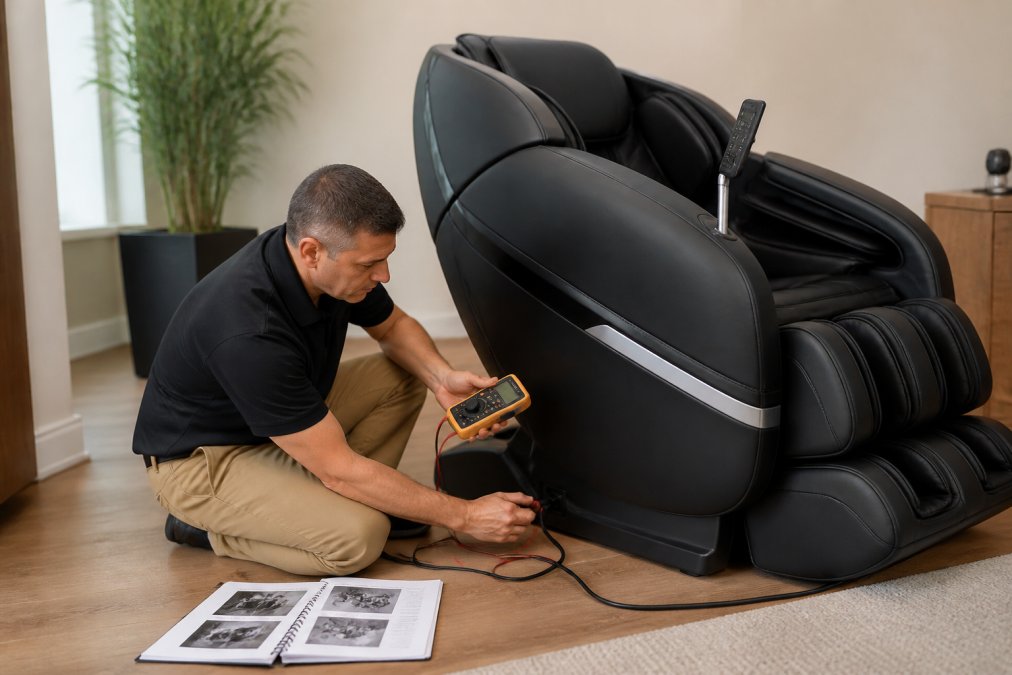
A dead chair is usually a power problem, not a motor problem. Work through supply, then reset, then codes, in that order, and you will solve the majority of failures without ordering a single part.
Hard Reset and Power Cycle Basics
Reset procedures vary by manufacturer and model. If the chair stops operating or displays a fault, follow the reset or power-cycle procedure in the owner’s manual rather than creating your own sequence. If the problem continues, record any error code and contact the manufacturer or service provider before opening the chair or replacing components.
Reading Error Codes and Status Lights
Error codes are the chair telling you which subsystem failed, and they are almost always worth reading before you touch anything. A blinking light paired with a code usually points to one of four areas: the actuator, the airbag inflation system, the solenoid valve, or the remote control connectivity (pubmed.ncbi.nlm.nih.gov).
Write the code down before you reset. Resetting first erases the evidence.
Remote Control Connectivity and Diagnostic Mode
Many chairs hide a diagnostic mode behind a button combination, and it lets you fire each motor and airbag individually. Check your service manual for the sequence, because it varies by model.
If the remote will not pair, test the batteries and the receiver before you assume the board is dead. Remote pairing failures are frequently a wiring harness issue at the connector, not a failed control panel.
Symptom |
Likely Cause |
First Fix |
|---|---|---|
No power at all |
Outlet, fuse, or power supply unit |
Test outlet, check fuse |
Powers on, then faults |
Actuator or airbag circuit |
Read code, run diagnostic mode |
Remote unresponsive |
Battery or receiver connection |
Re-pair, check harness |
Grinding noise |
Drive belt or roller assembly |
Inspect belt tension |
One zone dead |
Solenoid valve or wiring |
Continuity test on harness |
How to Find Massage Chair Replacement Parts
Finding the right part starts with the model number on the chair's rating plate, not with a search engine. Photograph that plate first, because it carries the model, serial number, and often the manufacture date you will need for any parts inquiry. Then photograph the failed component itself, from two angles, with a ruler or coin in frame for scale.
That second photo set is what separates a fast parts order from a three-week email chain. Most support teams cannot identify a part from a chair model alone, because the same model line often ships with different motors, air pumps, and control boards across production runs.
OEM Parts vs. Universal Components
OEM parts are made by the original manufacturer for your specific model. Universal components are generic equivalents that fit a range of chairs. OEM is the safer route for anything electronic or structural. Universal parts work well for mechanical items like rollers, belts, and fasteners.
The trap is discontinued models. When a manufacturer stops supporting a chair, OEM parts dry up and you are left hunting universal equivalents or salvaged components. This is exactly why buyers should ask about long-term parts support before purchase, not after.
How to Tell If a Non-OEM Part Will Actually Fit
This is the step most guides skip, and it is where DIYers get burned. Compatibility of non-OEM replacement parts can be more complicated than matching dimensions or connector style. Electrical ratings, mounting points, control electronics, sensors, firmware, travel limits, and other specifications may all matter. For motors, actuators, power supplies, control boards, wiring, and structural components, verify compatibility with the manufacturer or a qualified repair provider before installing a substitute part.
Where to Source Parts
There are four realistic channels, and each has a trade-off:
- Manufacturer or authorized dealer, correct part, warranty-safe, but may be slow or unavailable for older models.
- Specialty parts retailers, broader catalog and faster shipping, but you must verify compatibility yourself using the four checks above.
- Salvage and donor chairs, the only source for some discontinued boards and harnesses; inspect for corrosion and heat damage before buying.
- Generic component suppliers, best for belts, rollers, fasteners, and standard solenoids; weakest for proprietary control boards and remotes.
For anything electronic or structural, stay with OEM or an authorized source. For wear items, a verified universal part is usually fine and often cheaper.
Reading Schematics and Service Manuals
A schematic is a wiring diagram that shows how power and signal move between the control board, motors, and sensors. You do not need to read every symbol. You need to trace one circuit at a time.
Start at the component that is not working and trace backward toward the board. Nine times out of ten the break is at a connector, not mid-wire. Keep the schematic oriented the same way every time you look at it, and mark the circuit you are tracing with a pencil so you do not lose your place.
If you cannot find a schematic for your model, look for a service manual for a closely related model in the same line. Wiring conventions are often shared across a generation of chairs, even when part numbers differ.
Massage Chair Maintenance Tips That Prevent Breakdowns
Most guides are reactive: they tell you what to do after the chair breaks. A proactive routine is what actually extends service life, and it costs almost nothing. The goal is to catch wear before it becomes a failure, and to keep the mechanism and upholstery in the condition the manufacturer intended.
Follow your manufacturer's documentation for any lubrication, tension, or adjustment procedure. Recommendations vary by model, and applying the wrong lubricant to a track can attract grit and accelerate wear rather than reduce it.
The Component-by-Component Inspection Routine
Rather than a calendar of fixed intervals, work through the chair by system each time you inspect it. How often you inspect depends on how heavily the chair is used and what the manufacturer specifies, there is no universal schedule, so let your manual and your usage set the pace.
Track and roller assembly
- Clear dust, hair, and debris from the track channel; buildup is the most common cause of grinding and uneven travel.
- Check that no fabric, cord, or object obstructs the mechanism's full range of motion.
- Listen for changes in motor sound. A new whine, click, or strain often precedes a failure by weeks.
Airbag and inflation system
- Inspect air lines for kinks, pinches, or cracks where they bend around the frame.
- Check that airbags inflate and deflate fully and evenly; a slow-deflating bag can point to a solenoid or a small leak.
- Confirm no debris is trapped under a bag, which can cause uneven pressure and premature wear.
Upholstery and padding
- Wipe synthetic leather with a damp cloth, then dry it; avoid harsh solvents that strip the finish.
- Keep the chair out of direct sunlight to slow upholstery aging and cracking.
- Check seams and stress points around the seat and leg rest, where flexing is heaviest.
Electrical and control
- Use a surge protector to protect the control board from voltage spikes.
- Inspect the power cord and plug for fraying or heat marks.
- Confirm the remote and its cable or receiver connection are secure and free of strain.
Frame and fasteners
- Check that bolts and brackets remain snug; vibration loosens hardware over time.
- Look for cracks or flex at welded joints, especially on reclining mechanisms.
Why Obstruction Is the Silent Killer
That is why the track and roller check matters more than any cosmetic step. A chair that runs clean and unobstructed runs cool, and a cool motor lasts.
What to Leave to the Manufacturer's Instructions
Some adjustments are model-specific and should not be improvised: lubrication type and location, belt tension, and any calibration of the roller depth or zero-gravity positioning. Your manual is the authority here. If it does not specify a procedure, contact the manufacturer's support rather than guessing, because an incorrect adjustment can void coverage or damage a component that was working fine.
A Simple Habit That Pays Off
Before each session, take ten seconds to look and listen. Confirm nothing is in the mechanism's path, and note any new sound or sluggishness. Catching a small change early is almost always cheaper and easier than repairing a failed component later, and it keeps the chair ready for the relaxation routine you bought it for.
Massage Chair Warranty Coverage: What's Protected and What Isn't
Massage chair warranty coverage typically protects the frame and, for a limited period, the motors and electronics. It usually does not cover upholstery wear, cosmetic damage, or failures caused by unauthorized repair.

Read your warranty before you open the chassis. Many policies void coverage the moment a non-authorized party disassembles the unit, which means a DIY fix on a chair still under warranty can cost you more than the repair was worth.
Coverage length and what falls inside it vary widely by manufacturer and model, so check your own documentation rather than assuming a standard term.
When to Call a Technician Instead of DIY Repair
Call a technician when the problem is the control board, the main power supply, or anything involving the chair's structural frame. These repairs need diagnostic equipment, and a mistake can damage adjoining components.
Owner-serviceable items vary by manufacturer and model. Limit DIY work to procedures specifically identified in the owner’s or service manual, such as approved cleaning, basic external checks, or other manufacturer-authorized maintenance.
Repairs involving wiring, power supplies, motors, actuators, control boards, internal connectors, structural components, or electrical testing should be handled according to the manufacturer’s service guidance and may require a qualified technician. DIY disassembly or electrical work can create safety risks and may affect warranty coverage.
This is also where buying from a retailer that actually supports what it sells matters. RejuvaZone stocks full-body massage chairs and keeps a real support team available for post-delivery assistance, so a question about a control panel or a replacement component has somewhere to go. If you are still choosing a chair, the M9 Zero Gravity Massage Chair is built around 3D roller technology for deeper tissue work, while the Zero Gravity Massage Chair with 10 fixed rollers and heat therapy covers the essentials at a lower entry point. Both come with a touch screen controller, which makes the diagnostic functions easier to reach.
Frequently Asked Questions
What are the most common components that fail on a massage chair?
The parts that fail most often are the power supply unit, remote control, drive belt, actuator, and airbag solenoid valves. Roller assemblies and the wiring harness also wear over time. Most failures trace back to a single component rather than the whole mechanism, which is why a massage chair repair and parts guide starts with diagnosis. Check error codes and power flow first, then inspect belts and rollers for wear before ordering anything.
How do I find replacement parts for a discontinued massage chair model?
Start by locating the model and serial number on the chair's frame or under the seat cushion. Search the manufacturer's parts portal first, since OEM parts guarantee fit. If the model is discontinued, universal components like fuses, power cords, and some actuators may work, but measure the original part before buying. Third-party suppliers and repair forums can help, though always verify voltage and connector type against your service manual.
Is it safe to perform DIY repairs on a massage chair?
Basic fixes like hard resets, fuse replacement, and remote pairing are safe for most owners. Anything inside the chassis carries risk: capacitors in the power supply unit can hold a charge after unplugging. Unplug the chair, wait several minutes, and wear insulated gloves before touching the circuit board. If you are unsure about wiring or the actuator assembly, contact a technician. Electrical safety and multimeter usage are skills worth learning before opening anything.
How long should a massage chair last before major repairs?
Lifespan depends on build quality, usage frequency, and maintenance. Higher-end chairs with regular cleaning and belt inspections tend to last longer than budget models used daily. Common wear points like drive belts, rollers, and upholstery are usually the first to need attention. Following the manufacturer's maintenance recommendations and keeping the chair on a surge protector can extend service life. Individual results vary by model and how heavily the chair is used.